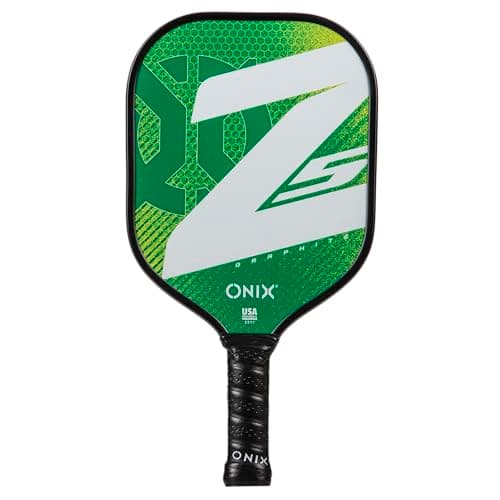
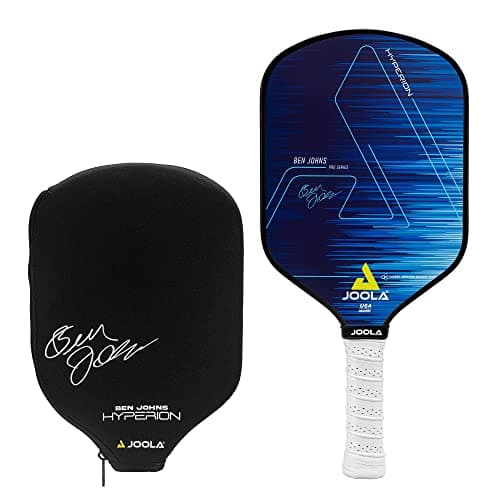
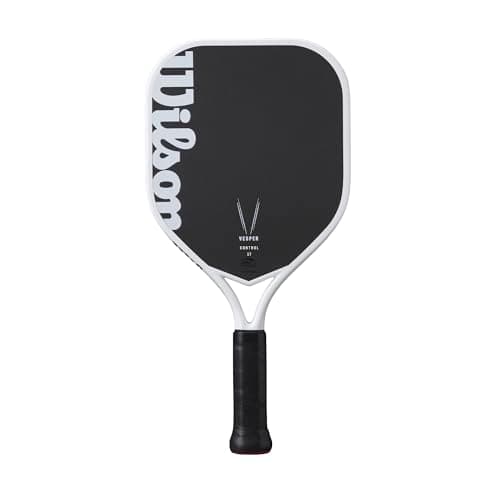
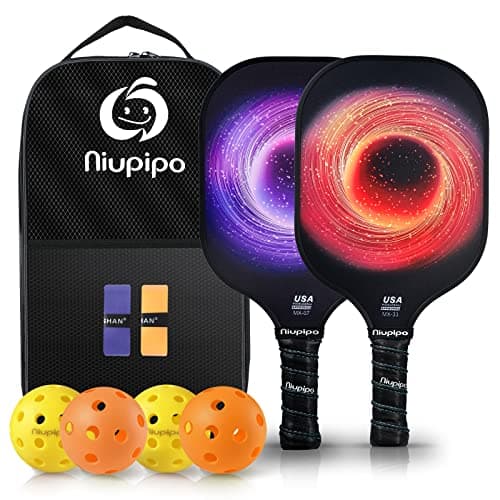
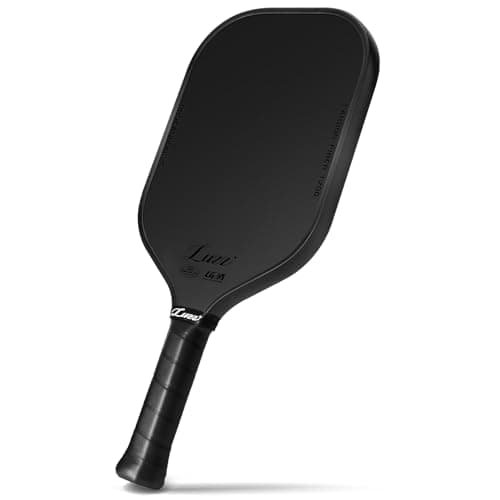
The highest overall score in our catalog belongs to the Luzz Cannon at 8.4 out of 10, and the five paddles below are not the five highest scorers — they are the paddle that leads each individual metric, which is a far more useful list. The Wilson Vesper has the best control score on the site (10). The JOOLA Hyperion has the best spin score (10). The Onix Z5 is the most forgiving (9). The Cannon leads power and value (9 and 9). The niupipo is the cheapest way onto the court. One of those is probably what you actually came for.
Every paddle we have scored
Twelve paddles, newest-scored last. Scores are out of 10 and are judgments from manufacturer-published specifications against the rubric on our methodology page— not measurements. Overall is the mean of the five metrics, to one decimal place.
| Paddle | Face / core | Ctrl | Pwr | Spin | Forgive | Value | Overall |
|---|
| Luzz Cannon | T700 carbon / 16mm floating | 8 | 9 | 9 | 7 | 9 | 8.4 |
| Luzz Pro 4 Tornazo | 3D grooved carbon / 16mm PeBaz | 9 | 9 | 9 | 8 | 6 | 8.2 |
| Franklin Signature Series Pro | MaxGrit / 16mm polypropylene | 8 | 7 | 8 | 8 | 9 | 8.0 |
| Vatic Pro Prism V7 | Raw carbon / 16mm foam-injected | 9 | 8 | 9 | 6 | 8 | 8.0 |
| Onix Graphite MOD Z5 | Graphite / Nomex honeycomb | 8 | 7 | 7 | 9 | 8 | 7.8 |
| JOOLA Ben Johns Hyperion | High-grit carbon / PP honeycomb | 8 | 8 | 10 | 6 | 7 | 7.8 |
| Luzz Inferno | T700 carbon / 16mm microporous | 8 | 8 | 8 | 9 | 6 | 7.8 |
| Wilson Vesper Control 17 | Control-tuned / 17mm | 10 | 6 | 8 | 8 | 6 | 7.6 |
| JOOLA Essentials Performance | Reinforced fiberglass / PP honeycomb | 8 | 7 | 6 | 8 | 8 | 7.4 |
| GAMMA Conqueror | Graphite composite / honeycomb | 8 | 7 | 6 | 7 | 8 | 7.2 |
| niupipo Fiberglass | Fiberglass / PP honeycomb | 7 | 6 | 5 | 8 | 9 | 7.0 |
| HEAD Radical Elite | Fiberglass / polymer honeycomb | 8 | 6 | 5 | 8 | 8 | 7.0 |
The leader in each metric
| Metric | Leader | Score | What it costs them elsewhere |
|---|
| Control | Wilson Vesper Control 17 | 10 | Power 6 — the lowest in the table |
| Spin | JOOLA Ben Johns Hyperion | 10 | Forgiveness 6 — a small sweet spot |
| Power | Luzz Cannon (tied) | 9 | Forgiveness 7 — stiff and elongated |
| Forgiveness | Onix Graphite MOD Z5 | 9 | Spin 7 — a mild face by modern standards |
| Value | niupipo / Franklin / Cannon (tied) | 9 | Very different paddles at very different prices |
That fourth column is the only honest way to read a chart like this. Nothing leads a metric for free. The Vesper's 10 for control is bought with the worst power score here; the Hyperion's 10 for spin is bought with a sweet spot that punishes imperfect contact. A paddle with no weakness in this table would be a paddle we had scored lazily.
How to actually use the chart
- Ignore Overall. It is the mean of five numbers that matter differently to different players, which makes it a reasonable tiebreak and a terrible shortlist. A 7.6 that leads control is a better paddle for a soft-game player than an 8.2 that does not.
- Pick the one metric your game is losing on. Resets dying in the net is a control problem. Not being able to end a rally is a power problem. Dinks that sit up is a spin problem. Mishits is a forgiveness problem. Read down that column only.
- Then read the face and core column. Two paddles with similar scores can arrive there by different routes, and the construction tells you which. A graphite face over Nomex behaves nothing like raw carbon over foam-injected walls.
- Check the price last.Prices on this site are live and move daily; the value scores above were set against the published spec, not against today's number. When a paddle is discounted hard its value score is understated, and the chart cannot know that.
What the chart cannot tell you
Three things, and they are the three that decide most purchases.
Weight.It is not a column here because most of these paddles do not publish one. Only the three Luzz models state a weight figure; the other nine either say nothing or say “mid-weight”, which is not a spec. Weight affects feel at least as much as anything in this table, and its absence is the single biggest hole in the category's published data. Our paddle weight guide covers what to do about that.
Grip size.Also not a column, for the same reason — it is published inconsistently and sometimes describes different measurements under the same label. It is also the one spec you can change yourself for the price of a sandwich, which is why we gave it a page of its own: our grip size guide.
How it feels in your hand. No chart does this, and ours is not an exception. We have not hit a ball with any of these twelve paddles. If a demo program or a club with loaner paddles is available to you, an afternoon with three of these beats every chart on the internet, including this one.
Where to go from here
This page is a reference, not a recommendation. If you want our picks rather than our data, the ranked roundups cut this same catalog by the thing you care about: by level at beginner, intermediate and advanced; by budget at under $50, under $100 and under $150; by playing style at control, power and spin; and by construction at carbon fiber and 16mm. The flagship best pickleball paddles page is the short answer if you want one paddle named and nothing else. Full written reviews of individual models live on our paddle reviews index.
Why we do not publish a tier list
People search for a paddle tier list, and we are deliberately not giving you one. A tier list collapses five independent axes into a single letter, and the collapse is where the information goes. The Wilson Vesper would sit in a middling tier on overall score while being the best control paddle we have scored — a tier list would actively mislead the exact player it should help. The table above is the same data without the lossy step.
Scores change, and we say when
Two things move a score here: a maker publishing a spec we previously could not cite, or a correction. Both have happened — the Onix Z5's face material was corrected from carbon to graphite once we read Onix's own catalog, which is disclosed on its review and in our editorial policy. If a number in this table changes, the change is dated on the page it came from.
What we cannot tell you
We have not physically tested any paddle in this chart, and we do not have a lab. Every spec is manufacturer-published and attributed on the individual product pages; every score is a judgment against the published rubric on our methodology page. The prices render from our live price pipeline with the date they were fetched, so a number on this page is never older than the stamp next to it.
How we picked
We have not physically tested this gear
Everyone in this category says they tested twenty paddles. We have not tested any — and we say so. What we did instead: compiled the manufacturer-published specifications (face material, core thickness, grip size, USAPA approval), normalized them, and scored each product against a published rubric weighted for the skill tier this page serves. The scores are judgments from documented research, not measurements we took, because we do not have a lab and are not going to pretend we do.